Office & Workplace Cleaning
The working floors served by the same washrooms, in one overall arrangement.
General Cleaning of Buildings
Washrooms, accessible facilities, showers and changing areas, shared kitchens and welfare rooms — cleaned to a documented routine using separated equipment, with consumables handled only on an agreed basis.
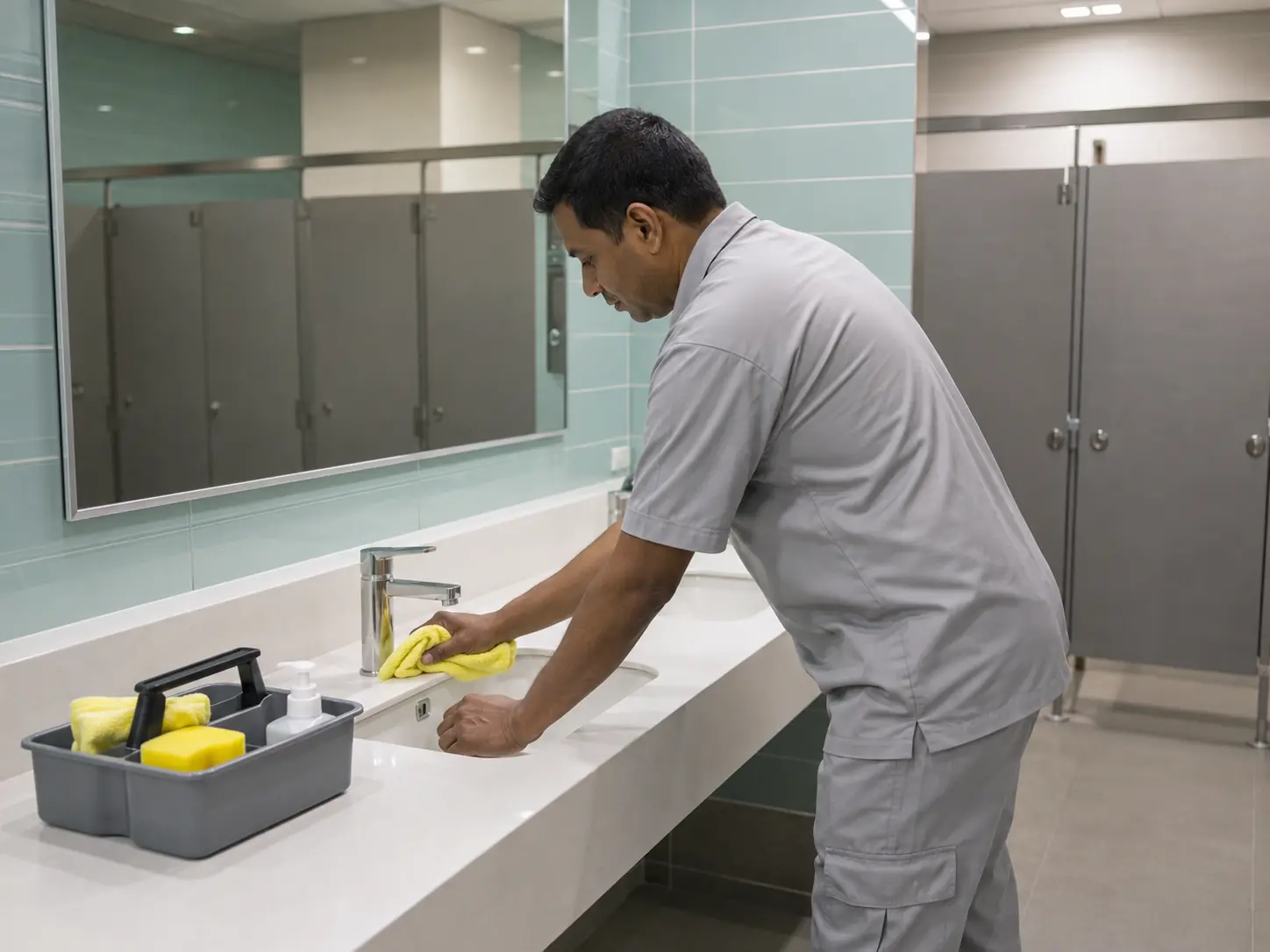
Colour-separated cloths and materials, kept exclusively for washroom use.
Service overview
A washroom that is right on six visits and wrong on the seventh is remembered as a bad washroom. It is the one area of a building where consistency is not a nicety — it is the entire standard.
This is also the part of a building where method matters most. Washroom cleaning done with the same cloths and mop as the kitchen is not cleaning, it is redistribution. Our washroom scopes use colour-separated equipment kept exclusively for that purpose, with materials chosen for the sanitary ware, tiling and grout actually installed rather than the strongest thing available.
Frequency is the other half of the problem. A washroom serving forty people needs a different pattern from one serving four, and the correct answer depends on peak use rather than headcount — a building with a single lunch hour concentrates almost all its demand into ninety minutes. We scope around that reality instead of applying a standard timetable.
On consumables, we take a deliberately explicit position: soap, paper and liners are only replenished where the products and the supply arrangement have been agreed in writing. Nothing frustrates a building manager more than assuming consumables were covered and finding the dispensers empty — so we make it a decision rather than an assumption.
Time on site
Published so you can plan around the attendance. Like our prices, these are indicative starting points rather than fixed commitments.
Approximately 4–8 hours Typical indicative duration
Indicative durations are based on a typical medium-sized agreed scope. Larger, heavily used or more complex premises may require additional time. The final schedule is confirmed after the property requirements, access and service scope have been reviewed.
Staffing is not fixed in advance either. How many people attend, and for how long, is determined once the scope, access and property requirements have been reviewed.
What moves the duration
Cubicles, urinals and basins drive the time far more directly than the room’s floor area.
Six small washrooms across six floors take longer than one large facility with the same fitting count.
Established scale and worn surfaces take longer to manage and limit the achievable finish.
Whether replenishment is in scope, and where stock is held, changes the time spent on site.
Suitable properties
Usually arranged alongside another scope — office, communal or retail — but equally available on its own where the washrooms are the specific problem to be solved.
Facilities serving a working floor, where peak demand is concentrated around arrival, lunch and the end of the day.
Washrooms in the retained parts of a multi-tenant building, used by occupiers and visitors from several different organisations.
Facilities available to the public in retail, hospitality-adjacent or consultation premises, where standards are visible to customers.
End-of-trip facilities, staff changing rooms and shower areas, where moisture management matters as much as surface cleaning.
Shared food preparation and break areas, cleaned with equipment kept separate from washroom use.
Accessible washrooms with grab rails, alarm cords and specific fittings that require careful, attentive cleaning.
The washroom system
Washroom work fails when method blurs. Each part below has its own equipment, its own routine and its own place in the written scope.
Sanitary ware, cubicles, basins, vanities, tiling and floors — cleaned with equipment kept exclusively for washroom use.
The surfaces every user touches, attended to on every visit rather than at a periodic interval.
Replenished only where the products and the supply arrangement have been written into the scope. Never assumed.
Showers, changing areas, staff kitchens and break rooms — cleaned with equipment kept separate from washroom use.
Preparation and sign-off
Colour-coded cloths and mops are prepared and stored apart before attendance, not sorted out on arrival. Materials are matched to the sanitary ware, tiling and grout actually installed rather than to whatever is strongest.
Each facility is checked against the documented routine before it is signed off, signage is removed once floors are dry, and anything cleaning cannot fix is reported as a building fault rather than absorbed into the next visit.
Possible inclusions
A realistic list of what can be included. Your written scope will confirm which apply, in which facilities and at what frequency — with periodic tasks listed separately so they cannot quietly disappear.
Working process
How many washrooms, how many cubicles and basins in each, who uses them and when the peaks fall. Peak concentration matters more than headcount — a single shared lunch hour puts almost all the demand into ninety minutes.
Before anything else is agreed, we settle whether NEATFIELD supplies consumables or you do, which products are used, where stock is held and who reorders. This is written into the scope rather than assumed, because an empty dispenser undoes an otherwise good clean.
Each task, each facility and each frequency written down — including periodic work such as descaling attention, grout lines, ventilation grilles and above-cubicle surfaces, with their own intervals so they do not get absorbed into the daily list.
Colour-coded cloths and mops kept exclusively for washroom use, and separately for kitchen areas. Materials are matched to the sanitary ware, tiling and grout on site. Signage goes out while floors are wet and comes in once they are dry.
A persistent odour, a slow drain, a failing extract fan, perished sealant, a cistern that runs — these are building faults, not cleaning faults, and no amount of attendance will resolve them. We tell you what we are seeing so it can be dealt with properly.
Before we attend
Neither list is a hurdle. Each item removes a round of questions, sharpens the quotation and reduces the chance of something being discovered on the day.
After the work
Washrooms are judged by their worst moment, so the close-out records exactly what was found.
If something is not right, tell us promptly and we will agree how to put it in order. That process is set out in our Terms and Conditions.
Consumables are a decision, not an assumption. The rest of this list is a matter of trade boundaries.
Pricing
An indicative starting price for an agreed service scope, published so you can judge the range before spending time on an enquiry.
How to read this figure Prices shown are indicative starting prices for an agreed service scope. The final quotation depends on the size and condition of the premises, cleaning frequency, access arrangements, working hours, staffing requirements, location, equipment, materials and any additional requirements. This price is not stated per hour, per visit, per week or per month unless an accepted quotation defines that basis. Consumable products, where supplied by NEATFIELD, are quoted separately from the cleaning itself.
Questions
Only where the products and the supply arrangement have been agreed in writing. We take this position deliberately. Consumables are a recurring cost that has to be owned explicitly by one side or the other, and “we assumed it was included” is the single most common cause of empty dispensers. Your scope will state who buys the products, which products they are, where stock is held and who is responsible for reordering — or it will state plainly that consumables are yours to manage.
Colour-separated equipment, kept exclusively for its own area. Cloths and mops used in washrooms are never used in kitchens or food areas, and the separation is maintained through storage and laundering as well as at the point of use. This is basic practice, but it is only reliable if the equipment is prepared and stored properly before attendance — which is why preparation matters as much as the cleaning itself.
Almost always because the cause is not surface soiling. Persistent washroom odour usually traces to a dry or damaged trap, a failing extract fan, perished sealant allowing moisture behind a fitting, or urine that has penetrated grout or a floor junction over a long period. More frequent cleaning will not resolve any of those. We will tell you what we think is happening so it can be investigated properly, rather than selling you additional attendance that cannot fix it.
Visible limescale on taps, sanitary ware and shower screens is addressed with appropriate materials as part of the routine, and periodic descaling attention can be scoped where the water is hard. What we cannot do is guarantee removal of scale that has etched or bonded into a surface over years, or descale systems, cisterns and pipework internally — that is a plumbing matter. Where scale has permanently marked a chrome or ceramic finish, we will tell you rather than keep charging to attack it.
Yes, and in busy buildings it is often the right answer. A washroom cleaned only at six in the morning has to survive an entire working day unattended. A mid-day check — restocking, a quick reset of surfaces and floors — costs far less than the reputational damage of a facility that fails by mid-afternoon. Attendance patterns and hours are agreed in the quotation.
Sanitary waste units can be serviced where a supply and collection arrangement exists and has been agreed — the disposal itself is a licensed waste matter that must be properly arranged. We do not undertake clinical waste handling, sharps recovery or biohazard cleaning under this service. Where those requirements exist, they need to be addressed by a suitably equipped specialist rather than folded into a cleaning scope.
Related services
All services
Next step
Number of washrooms, cubicles and basins, roughly how many people they serve, and whether you want us to handle consumables. We will come back with questions, then a written scope and quotation.