Office & Workplace Cleaning
Daily spot cleaning of doors and screens between dedicated glass passes.
Other Cleaning Services
Internal partitions, meeting-room glazing, balustrades, glass doors, mirrors and the inside face of windows — cleaned from within the building, where the work can be reached safely from the floor or from ordinary access equipment.
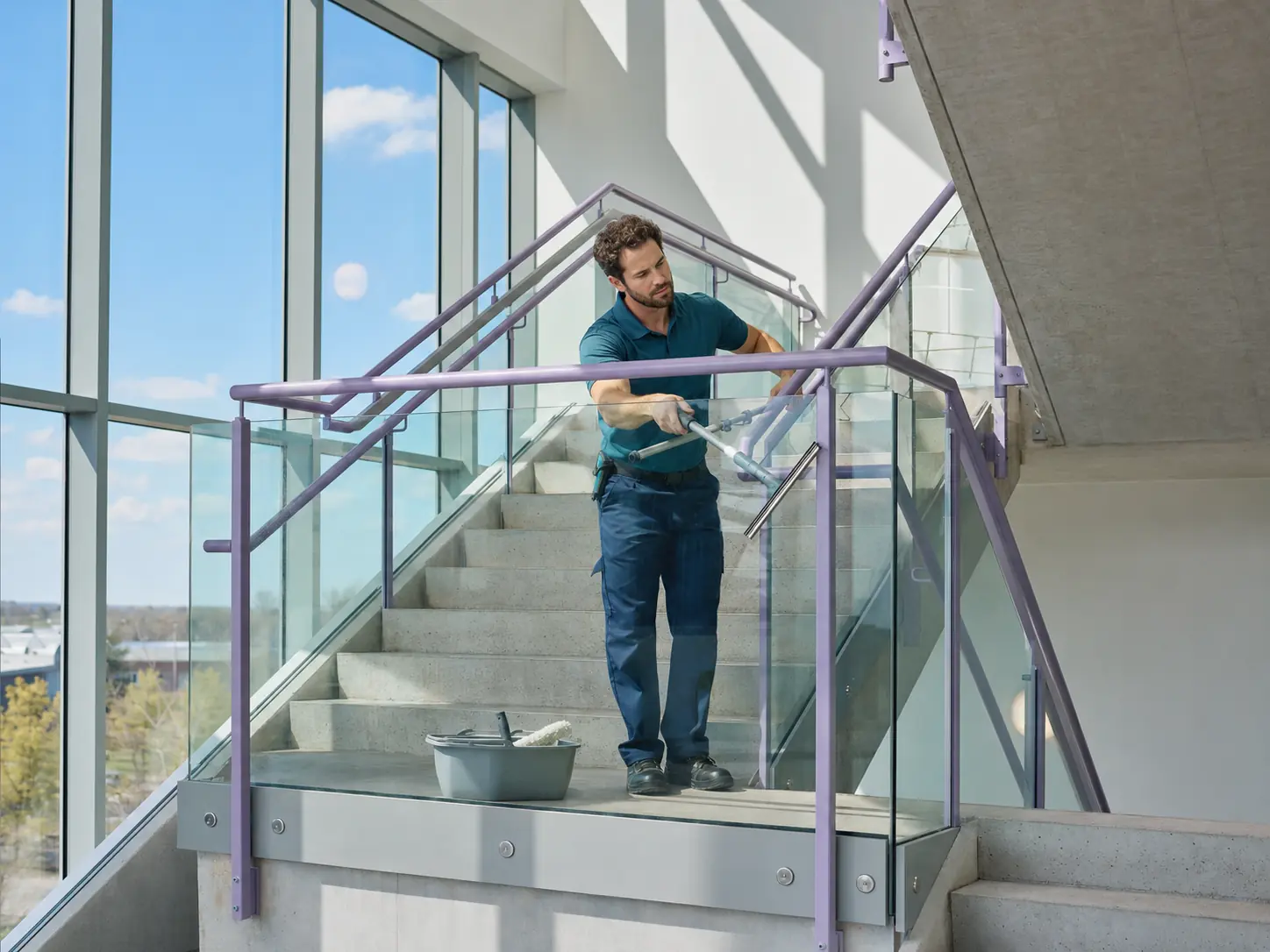
Internal balustrades and partitions worked from inside the building, at ordinary reach.
Service overview
A partition that is ninety per cent clean reads as dirty, because glass is judged in raking light by the marks that remain rather than the area that does not have any.
Modern commercial interiors are full of it — meeting-room walls, acoustic screens, balustrades, entrance screens, door leaves, full-height mirrors. Most routine scopes include spot cleaning of glass within reach, and for day-to-day fingerprints that is the right level. What routine cleaning does not do is bring an entire glazed elevation to a consistent, mark-free finish, because that needs proper tools, the right solution strength and enough uninterrupted time to work a whole run in sequence.
That is what this service is: a dedicated pass over the glass, worked systematically rather than opportunistically, with attention to the details that spoil the effect — the edges, the frame junctions where solution collects, the manifestation strips that collect dust, the door furniture and the track beneath a sliding leaf.
The boundary of this service is deliberate and specific. It covers ordinary internal glass reachable safely from the floor or from ordinary access equipment such as steps or a low platform used within manufacturer limits. Specialist high-level work, and any external access, is a different discipline with different equipment, different training and different risk — it is not included, and it is quoted separately only after being assessed on its own terms.
Time on site
Published so you can plan around the attendance. Like our prices, these are indicative starting points rather than fixed commitments.
Approximately 4–8 hours Typical indicative duration
Indicative durations are based on a typical medium-sized agreed scope. Larger, heavily used or more complex premises may require additional time. The final schedule is confirmed after the property requirements, access and service scope have been reviewed.
Staffing is not fixed in advance either. How many people attend, and for how long, is determined once the scope, access and property requirements have been reviewed.
What moves the duration
The biggest single factor. Glass at standing reach is quick; glass needing a platform and a second person is not.
Many small panes with frames between them take far longer than the same area in large sheets.
Partitions reachable from both faces are effectively twice the work.
Fixed furniture, planting and equipment under a glazed run slow the work considerably.
Suitable properties
Arranged as a periodic pass alongside a routine scope, as part of a wider reset, or as a single piece of work before a specific date.
Meeting rooms, focus booths and acoustic screens where glass forms most of the internal wall area.
Stair cores, mezzanines and atrium edges where balustrades are visible from several levels at once.
Entrance screens, revolving and sliding door leaves, and internal lobby glazing seen by every visitor.
Display cabinets, mirrors and the internal face of shopfront glass, which shows every mark in daylight.
Entrance screens, vision panels, internal lobby glazing and mirrors in the retained parts of a building.
Where glass carries protective film residue, labels or plaster splash and needs a proper first clean.
Glazed surfaces
Glass is judged in raking light by the marks that remain, not the area that has none. What decides the work is not the glass itself but how safely it can be reached.
The inside face of external windows and curtain walling, together with the sills, reveals and frames immediately around the glass.
Meeting-room glazing, acoustic screens and glazed booth enclosures — both faces where both faces are accessible.
Internal glass doors, leaves, side panels, over-panels and the glazed sections set within solid doors, plus the door furniture around them.
Full-length, wall-mounted and washroom mirrors polished to a mark-free finish, checked from the angle they will actually be used at.
Glass balustrades to stairs, landings and mezzanines, with handrail junctions, base channels, fixing points and the sills beneath.
Every element is checked for whether it can be worked safely from the floor or from ordinary access equipment. Anything beyond that is identified and excluded rather than reached for.
Possible inclusions
Your quotation will confirm which glazed elements are included and the access method for each — because the access method, more than the glass area, determines what the work costs.
Ordinary internal glass, as covered by this service, means glazing that can be reached and worked safely from the floor, or from ordinary access equipment such as steps or a low working platform used within manufacturer limits, with adequate clear floor space beneath.
Working process
We work out what glass is in scope and, crucially, how each element can be reached safely. Height, obstruction, floor clearance and whether both faces are accessible all decide the method — and anything that cannot be reached safely is identified and excluded at this stage rather than attempted later.
Scratching, etching, failed seals, internal condensation and lifting film are pointed out before work begins. These do not respond to cleaning, and identifying them in advance prevents an entirely reasonable expectation from turning into a disappointment.
Floors beneath glazing are protected and signed where necessary, because glass work involves solution running down onto whatever is below. Adjacent finishes, sills, timber reveals and floor junctions are considered before the first pane is wetted.
Glass is worked in sequence rather than opportunistically, so a whole elevation reaches a consistent finish. Frame junctions and channels are dried, because solution collecting in a gasket will run out later and leave exactly the streak the work was meant to eliminate.
The finish is inspected from the angle it will actually be seen from, not straight on. Marks on glass are invisible face-on and obvious at a glance from the side, which is why a final check from the room's natural viewpoint is part of the job rather than an optional extra.
Before we attend
Neither list is a hurdle. Each item removes a round of questions, sharpens the quotation and reduces the chance of something being discovered on the day.
After the work
Glass is checked from the angle it will actually be seen from, which is rarely straight on.
If something is not right, tell us promptly and we will agree how to put it in order. That process is set out in our Terms and Conditions.
This service covers glass worked from inside the building, at ordinary reach. The boundary is deliberate.
Pricing
An indicative starting price for an agreed service scope, published so you can judge the range before spending time on an enquiry.
How to read this figure Prices shown are indicative starting prices for an agreed service scope. The final quotation depends on the size and condition of the premises, cleaning frequency, access arrangements, working hours, staffing requirements, location, equipment, materials and any additional requirements. This price is not stated per hour, per visit, per week or per month unless an accepted quotation defines that basis.
Questions
No. This service covers glass worked from inside the building — including the inside face of external windows. The outside face, facade cleaning and anything requiring access from outside the building is a separate discipline needing different equipment, different training and a different risk assessment. It is not included and is not implied. If you need both, say so in your enquiry and we will be clear about which part we can quote for.
Glass that can be worked safely from the floor, or from ordinary access equipment such as steps or a low working platform used within its manufacturer limits, with adequate clear floor space beneath. Beyond that — atrium glazing, stairwell voids, double-height elevations, rooflights — you are into specialist access, which means platforms, towers or rope access. That is not part of this service and would need to be assessed, agreed and quoted entirely separately.
Usually defects rather than soiling. Scratching, etching from hard water or splashed cement, pitting, and delamination are physical damage to the glass surface and no cleaning process removes them. Condensation or misting between the panes of a sealed unit means the seal has failed and the unit needs replacing. We identify these before starting so you know what the finish will and will not look like.
Not under this service. Removing bonded residues — paint, adhesive, silicone, cement splash — requires blade work or solvents, and both carry a genuine risk of scratching glass or damaging any coating on it, particularly on toughened or coated panes. Light residue after a fit-out is often addressed within post-works cleaning, where the work is assessed and agreed with that risk understood in advance.
Partly. Circulation glazing, balustrades and lobby screens can usually be done during the day with appropriate floor protection and signage. Meeting-room glass generally cannot, because the room needs to be empty and the work is visible and mildly disruptive. The usual arrangement is a combination: occupied areas during the day, meeting rooms and client-facing glass outside hours. Your scope will state which is which.
It depends entirely on traffic and use. Door leaves and entrance screens in a busy building show marks within hours and are usually best covered by daily spot cleaning within a routine scope, with a full dedicated pass periodically. Meeting-room partitions and balustrades in lower-traffic areas hold a good finish much longer. We would rather propose a realistic interval for your building than sell attendance you do not need.
Related services
All services
Next step
Roughly how many partitions, screens or balustrade runs, whether both faces are accessible, and whether anything sits above ordinary reach. That last point matters most.