Washroom & Shared Facility Cleaning
For buildings with shared washrooms or welfare facilities in the retained parts.
General Cleaning of Buildings
The shared parts of a managed building — entrances, lobbies, post box walls, stairwells, landings, lift interiors and corridors — cleaned to an agreed routine that residents, tenants and visitors can rely on.
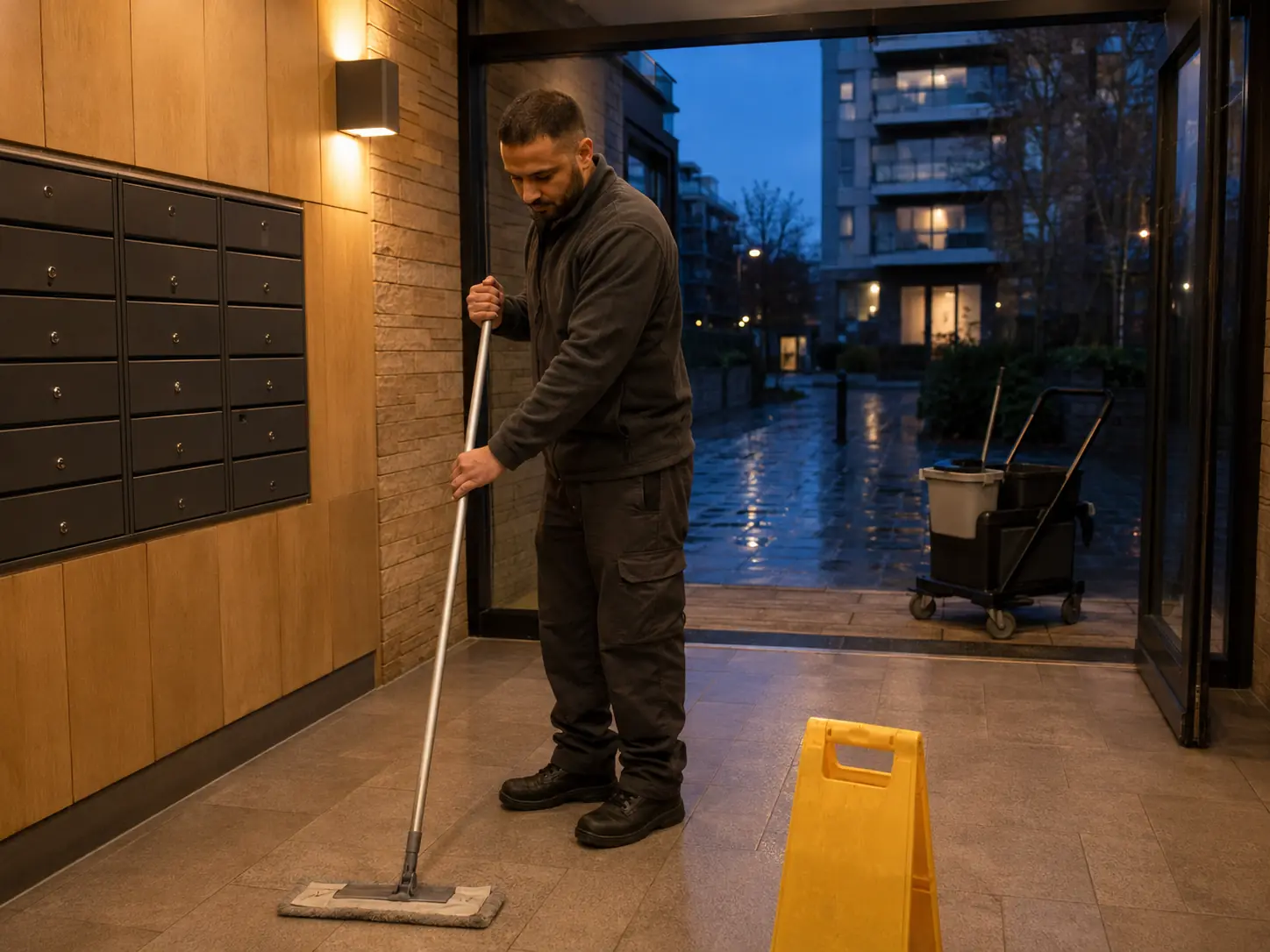
Entrance floors cleaned with signage in place, because communal areas are never fully closed.
Service overview
That is exactly why it deteriorates. No single occupier feels responsible for the lobby floor, the stair nosing or the smear on the entrance glass, so nothing happens until somebody complains.
Communal cleaning is the most visible work a managing agent commissions. It is the first thing a prospective tenant sees, the thing residents mention at every meeting, and the easiest thing to be criticised for. It is also unusually demanding to deliver well, because the space is in continuous use — there is no closing time, no empty building and no moment when the entrance is not somebody's route home.
We scope communal work around traffic and weather rather than floor area. An entrance takes the brunt of everything walked in from outside; the fourth-floor landing does not. Matting, thresholds and the first few metres of hard floor carry most of the soiling in the whole building, and a scope that treats them the same as a quiet corridor is a scope that will disappoint.
Safety signage is used whenever floors are wet, and work is sequenced so that a route through the building always remains available. Fire doors are never wedged, propped or obstructed, and escape routes are kept clear at every stage.
Time on site
Published so you can plan around the attendance. Like our prices, these are indicative starting points rather than fixed commitments.
Approximately 4–8 hours Typical indicative duration
Indicative durations are based on a typical medium-sized agreed scope. Larger, heavily used or more complex premises may require additional time. The final schedule is confirmed after the property requirements, access and service scope have been reviewed.
Staffing is not fixed in advance either. How many people attend, and for how long, is determined once the scope, access and property requirements have been reviewed.
What moves the duration
Two stair cores of six storeys is a very different job from one core of twelve.
Whether equipment can be moved by lift, or has to be carried, changes the time significantly.
A street-level entrance in constant use accumulates far more than a gated courtyard approach.
Stone, terrazzo, tile, timber and carpet each need different materials, machines and methods.
Suitable properties
Typically commissioned by managing agents, residents' management companies, freeholders, landlords and in-house property teams — though we are equally happy to deal with a resident director directly.
Purpose-built apartment buildings with shared entrances, lifts, stair cores and corridors serving multiple private dwellings.
Buildings combining residential floors with commercial units at ground level, where the two uses share entrances or service routes.
Office and light commercial buildings where the landlord retains responsibility for lobbies, lifts, stairs and shared corridors.
Older conversions with original stone, timber or tiled finishes that need appropriate materials rather than whatever is strongest.
Buildings with high turnover and heavy communal traffic, where entrance and stair cleaning carries most of the visible load.
Shared business premises where the communal impression is part of what occupiers are paying the operator for.
Entrance first
Matting, thresholds and the first few metres of hard floor carry most of the soiling in the entire building. A scope that treats them like a quiet upper landing is a scope that will disappoint.
The property route
Communal scopes are weighted by traffic rather than floor area. This is the route an attendance follows, and roughly how much of the effort each stage takes.
Matting lifted and the well beneath cleaned, thresholds detailed, entrance doors and glazed panels cleaned within reach, entry panels and door furniture wiped.
Post box faces and the surrounding wall, notice boards, any concierge surfaces, and the first run of hard floor that takes the brunt of the weather walked in.
Car floors cleaned with materials suited to the finish, stainless and mirrored surfaces polished, call buttons and control panels wiped, door tracks cleared of debris.
Treads, risers, nosings and landings cleaned in sequence, with handrails, balustrades and spindles wiped throughout the core.
Corridor floors vacuumed or mopped to suit the finish, flat entrance doors, frames and adjacent wall areas attended to at the agreed interval.
Handles, push plates, switches, intercoms and rails — the surfaces every resident contacts and nobody owns. Cobwebs cleared from corners and stairwell voids.
Possible inclusions
A realistic list of what can be included. Your written scope will confirm which apply to your building, in which areas and at what frequency — entrances typically need more attention than upper landings.
Working process
Communal scopes are difficult to write from a description alone, because the difference between a well-used entrance and a quiet top landing only becomes obvious on site. Where the building's size or condition warrants it, we arrange to walk it from the entrance up.
Entrances, matting and thresholds take most of the soiling in the building and normally need the most frequent attention. Upper landings and low-traffic corridors are scoped at appropriate intervals rather than treated identically, which puts the effort where it shows.
Fobs, codes, key safes, alarm procedures, bin store access, where water and power can be taken from, and who to contact about a defect. Any building rules imposed on contractors are recorded before the first attendance.
Work is sequenced so that residents and occupiers always have a clear route. Signage goes out before floors are wet and comes in once they are dry. Fire doors stay closed and escape routes stay clear at every stage of the work.
You hear what was done, what could not be completed and why, and anything we noticed about the building — a failing door closer, a light out in the stair core, damage to a floor finish, a leak staining a ceiling. Communal cleaners see a building more often than anyone else, and that is worth passing on.
Before we attend
Neither list is a hurdle. Each item removes a round of questions, sharpens the quotation and reduces the chance of something being discovered on the day.
After the work
Communal work finishes with a report, because you are rarely on site to see it.
If something is not right, tell us promptly and we will agree how to put it in order. That process is set out in our Terms and Conditions.
Communal buildings carry obligations that cleaning must never compromise.
Pricing
An indicative starting price for an agreed service scope, published so you can judge the range before spending time on an enquiry.
How to read this figure Prices shown are indicative starting prices for an agreed service scope. The final quotation depends on the size and condition of the premises, cleaning frequency, access arrangements, working hours, staffing requirements, location, equipment, materials and any additional requirements. This price is not stated per hour, per visit, per week or per month unless an accepted quotation defines that basis.
Questions
Communal areas never close, so the question is not when the building is empty but when it is quietest — usually mid-morning in residential blocks, and outside core hours in commercial buildings. We sequence the work so that a clear route through the building is always available, use signage while floors are wet, and never obstruct an escape route. The agreed timing goes into your quotation.
We clean around them and report them to you. We do not move, remove or dispose of residents' belongings — pushchairs, bicycles, parcels, furniture awaiting collection. Those items may be somebody's property and may also be a fire safety matter for the managing agent to address formally. What we can do is tell you consistently what is appearing and where.
The approach to the bin store and the refuse route through the building can be included in the scope. The interior of the store, washing of containers, and moving or presenting bins for collection are separate matters that we would need to assess and agree specifically — they involve different equipment, different waste considerations and often different access. They are not assumed to be included.
The inside face of glazing that can be reached safely from the floor or from ordinary access equipment, yes — that falls under Interior Glass Cleaning and can be included alongside a communal scope. External glazing, and any internal glazing at atrium or stairwell-void height requiring specialist access, is a separate discipline that must be assessed, agreed and quoted on its own terms.
Not a problem, but it does change the method. Natural stone, terrazzo and original tile are damaged by aggressive or unsuitable chemistry, and a floor that has been stripped incorrectly is expensive to recover. We select materials for the actual finish, which sometimes means a more careful and slower approach with a realistic ceiling on what can be achieved. Where a floor has already been damaged, we will say so rather than imply cleaning will reverse it.
Yes. Cleaners are in a communal building more regularly than almost anyone else, and they notice things — a door closer failing, a light out in the stair core, water staining that was not there last week, a lock that no longer turns cleanly. Passing that on is part of the service. It is observation and reporting, not inspection: we are not surveyors and do not offer any assessment of the building's condition.
Related services
All services
Next step
How many cores and levels, whether there is a lift, what the entrance floor is, and how much traffic the building takes. We will come back with questions, then a written scope and quotation.