Carpet & Upholstery Cleaning
Extraction cleaning of carpets and soft furnishings as part of the same reset.
Other Cleaning Services
A single intensive attendance working through an itemised list of areas that routine cleaning does not reach — behind and beneath equipment, inside cupboards and appliances, and across accumulated build-up on hard surfaces.
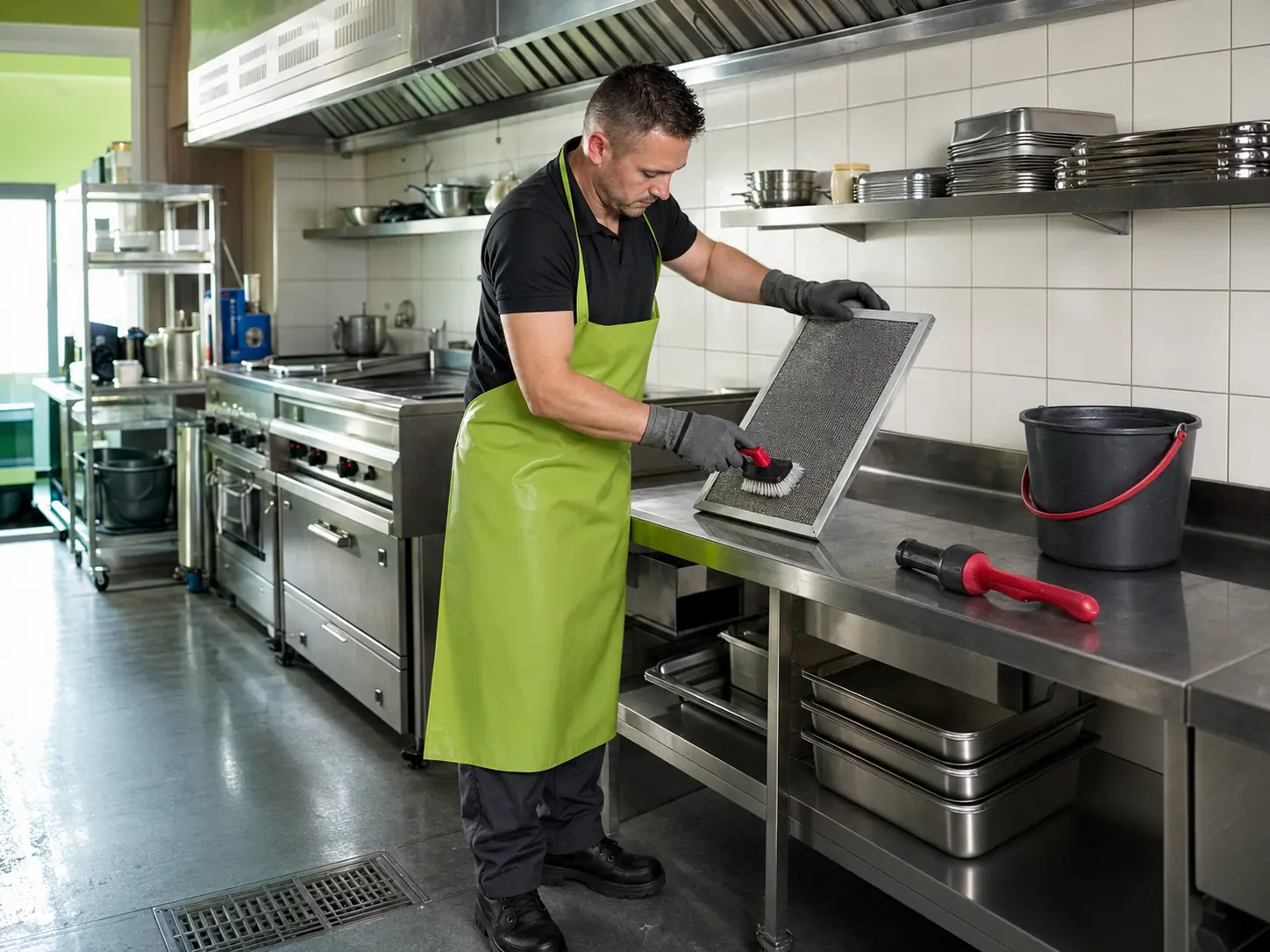
Components removed, cleaned individually and refitted — the part of the job routine attendance never reaches.
Service overview
“Deep clean” is the most abused phrase in this industry. It is used to mean anything from a slightly longer routine visit to a full strip-down, and the gap between those two is where most disputes begin.
We treat a deep clean as an itemised list of specific tasks in specific places, agreed before anyone attends. Not “deep clean the kitchen” but a written schedule: extraction filters removed and degreased, equipment pulled forward and the wall and floor behind cleaned, cupboard interiors emptied by your team and cleaned by ours, and so on. If it is not on the list, it is not in the price — and you can see exactly what you are buying.
We are equally careful about what this service is not. It is a thorough physical clean to an agreed standard. It is not sterilisation, it is not disinfection to a validated level, and it does not carry any certification. Where a property needs a specific hygiene outcome demonstrated — in a regulated food or clinical setting — that requires a specialist with the appropriate protocols, testing and accreditation, and we will say so rather than take the work.
A deep clean is also the right starting point for a neglected property. Routine cleaning maintains a standard; it cannot create one. Establishing a baseline first, then holding it with a general cleaning scope, is usually both cheaper and more effective than paying for routine visits that are quietly fighting a backlog.
Time on site
Published so you can plan around the attendance. Like our prices, these are indicative starting points rather than fixed commitments.
Approximately 1–2 working days Typical indicative duration
Indicative durations are based on a typical medium-sized agreed scope. Larger, heavily used or more complex premises may require additional time. The final schedule is confirmed after the property requirements, access and service scope have been reviewed.
Staffing is not fixed in advance either. How many people attend, and for how long, is determined once the scope, access and property requirements have been reviewed.
What moves the duration
The single largest factor. Accumulated grease or heavy build-up multiplies the time required.
Surfaces and floors only, or a full strip-down with equipment moved and cupboards cleared.
A clear space is dramatically more efficient than one that has to be worked around.
Degreasing chemistry needs time to work, and wet floors need time to dry before the area returns to use.
Suitable properties
Commissioned as a one-off reset, as the opening move before a routine scope begins, or as a periodic event scheduled once or twice a year alongside existing arrangements.
Extraction canopies and filters, equipment fronts and sides, wall and floor junctions, and the areas behind and beneath fixed appliances.
Establishing a baseline so recurring attendance has something realistic to maintain rather than a backlog to fight.
Before letting, sale, reoccupation or a change of tenant, where the space needs to present as genuinely reset.
Buildings that have stood empty or lightly used and need a thorough clean before returning to normal operation.
Where a specific date matters and the space needs more attention than the routine scope was ever designed to deliver.
Properties taken on in poor condition, where the extent of the work has to be assessed honestly before any price is meaningful.
Itemised, not implied
Not “deep clean the kitchen” but a written schedule: the canopy, the filters, the equipment to be moved, the cupboards to be cleared and the floor junctions to be addressed.
How a deep clean runs
Deep cleaning is methodical rather than dramatic. Each phase has to finish before the next begins, or the work simply undoes itself.
The itemised schedule is walked on arrival and checked against what is actually in front of us. Anything materially different from the assessment is raised before work starts, not after.
The areas you identified as mattering most are tackled while the team is freshest and the dwell times can be managed properly.
High level first, then surfaces and fittings, then equipment fronts and sides. Degreasing chemistry is given the dwell time it actually needs rather than the time available.
Behind and beneath mobile equipment, inside cleared cupboards, along floor and wall junctions, and the coving and gully surrounds that routine attendance never reaches.
Floors last, then a walk-round against the itemised list with you. Anything incomplete, and anything found beneath the soiling, is recorded.
Possible inclusions
A realistic menu rather than a fixed package. Your itemised scope will name exactly which of these apply, in which areas — because on this service, the itemisation is the product.
Working process
This service cannot be quoted from floor area. We need to understand what state the property is genuinely in — through detailed questions and photographs, and through a visit where the scale or uncertainty justifies one. An honest assessment protects both sides from a conversation about extras halfway through.
Every task is written down against a specific area. Not “deep clean the kitchen” but a schedule naming the canopy, the filters, the equipment to be moved, the cupboards to be cleaned and the floor junctions to be addressed. The itemisation is what you are actually buying.
What your team clears beforehand, whether the space will be empty, how long it can be out of use, where water, power and waste disposal are available, and whether the work happens in one attendance or across a planned sequence.
Deep cleaning is methodical rather than dramatic: top down, section by section, with the right chemistry given the dwell time it actually needs. Anything found to be unsuitable for the intended method, or already damaged beneath the soiling, is raised at the time rather than after.
At completion we go through the itemised list with you so you can see what was done against what was agreed. Anything that could not be completed, and why, is recorded — along with anything we found that you should know about, such as a failed seal or a floor finish worn beyond recovery.
Before we attend
Neither list is a hurdle. Each item removes a round of questions, sharpens the quotation and reduces the chance of something being discovered on the day.
After the work
A deep clean closes with a walk-round against the itemised list, because the itemisation is what you actually bought.
If something is not right, tell us promptly and we will agree how to put it in order. That process is set out in our Terms and Conditions.
This is a detailed agreed scope of physical cleaning. It is not sterilisation, validated disinfection or a certified hygiene outcome.
Pricing
An indicative starting price for an agreed service scope. Of all our services, this is the one where the final figure depends most heavily on the condition we find.
How to read this figure Prices shown are indicative starting prices for an agreed service scope. The final quotation depends on the size and condition of the premises, cleaning frequency, access arrangements, working hours, staffing requirements, location, equipment, materials and any additional requirements. This price is not stated per hour, per visit, per week or per month unless an accepted quotation defines that basis.
Questions
No. This is a detailed agreed scope of physical cleaning, and we describe it that way deliberately. We do not claim sterilisation, we do not claim disinfection to a validated level, and we do not issue certification. Where a regulated hygiene outcome has to be demonstrated — in a food business subject to inspection, or in a clinical environment — that needs a specialist working to defined protocols with appropriate testing and accreditation. We will tell you that rather than take work we cannot properly stand behind.
Because the honest answer depends on condition, and condition is exactly what a description leaves out. Two kitchens of identical size can differ by a factor of three depending on how long since the extraction was last touched. We would rather ask for photographs, ask more questions, and visit where it is warranted, than give you a confident number that becomes a conversation about extras once we are on site.
Where practical, yes — and it changes the price meaningfully. Cupboard and drawer interiors are cleaned only where your team has cleared them beforehand, because we are not in a position to decide what should be thrown away or where it belongs. For floors and behind-equipment work, a clear space is dramatically more efficient. Whatever is agreed will be stated in the quotation so it can be arranged rather than discovered on the day.
Mobile equipment on castors, yes, where it is safe and practical and has been agreed. Fixed equipment, and anything gas-connected, plumbed in, hard-wired or heavy enough to require specialist handling, is not moved or disconnected by us. Where cleaning behind such equipment matters, it needs a suitably qualified engineer to disconnect and reconnect it, arranged separately and scheduled around our attendance.
It depends entirely on the scope, and it will be stated in your quotation rather than left vague. Areas involving wet floor work or chemistry with a dwell time need to stay out of use until they are dry and ventilated. Where the property cannot be closed, we can often plan the work as a sequence across several attendances, area by area — that takes longer overall but keeps the premises operating.
No. Cleaning removes soiling; it does not repair. Where a floor finish has worn through, a worktop is scored, sealant has perished or a surface has been permanently stained or etched, a deep clean will reveal that more clearly rather than reverse it. We would much rather tell you before the work that a particular surface will look better but not new, than have you expect restoration and receive cleaning.
Related services
All services
Next step
For deep cleaning, photographs are worth more than any description. Tell us what the space is, what state it is in, when it needs to be ready and whether it can be cleared.