Washroom & Shared Facility Cleaning
Documented washroom routines with separated equipment, in the same overall arrangement.
General Cleaning of Buildings
Recurring cleaning of the floors people actually work on — desks and shared surfaces, meeting rooms, breakout areas, tea points, reception and circulation space — delivered to a written routine around the working day.
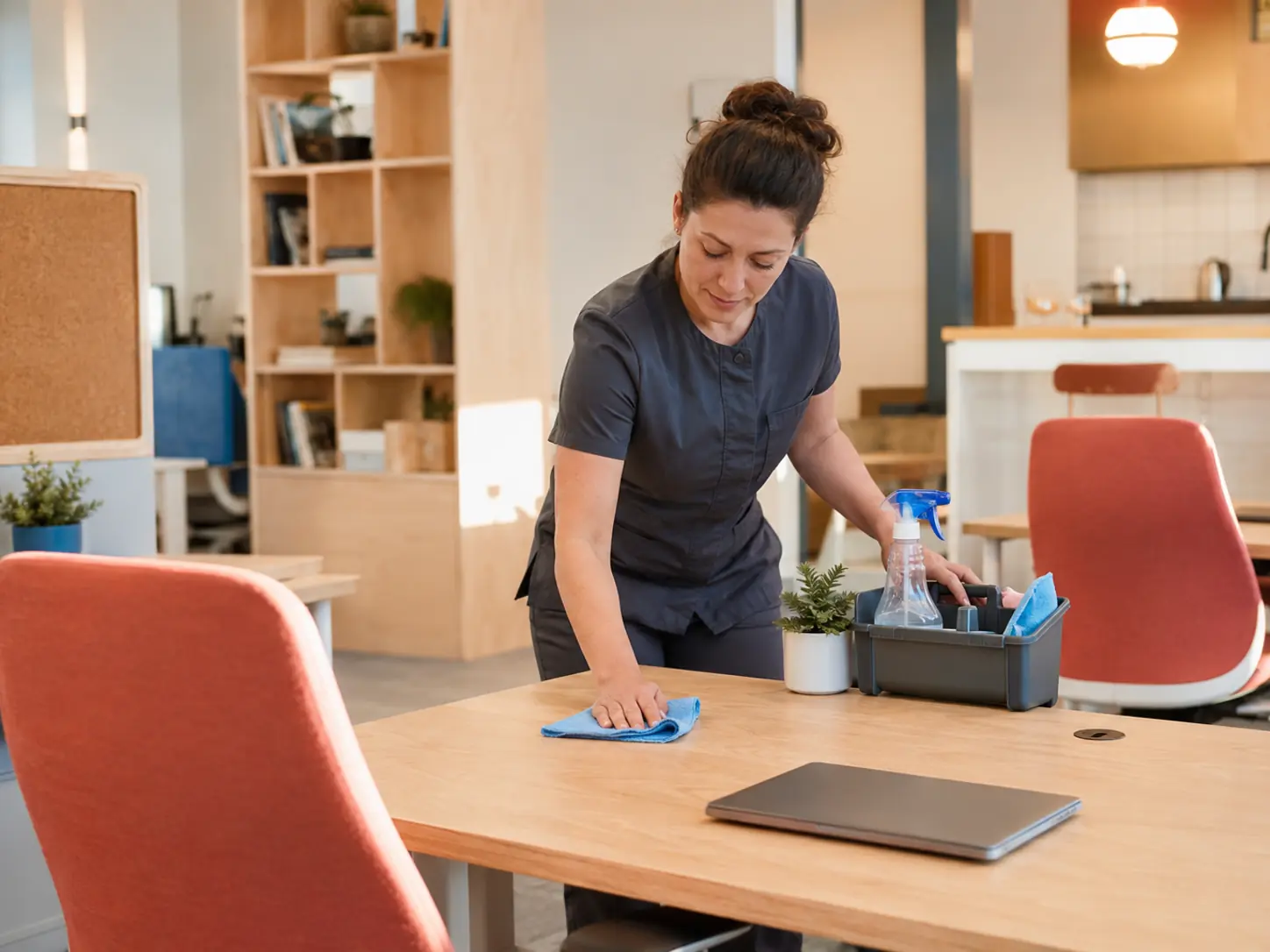
Desks and shared surfaces cleaned to a written routine rather than by whatever looks worst.
Service overview
Nobody notices a clean office. They notice a sticky meeting-room table, a bin that was not emptied on Friday, a keyboard tray of crumbs and the ring left on a desk by somebody's mug.
Office cleaning is unusual among cleaning disciplines because the same people see the result every day. That makes consistency worth far more than intensity: a scope that is delivered fully on every attendance beats an ambitious one that gets abbreviated whenever the clock runs short.
We build an office scope around how the floor is actually used — where people eat, which rooms turn over constantly, which desks are hot-desked and which are permanently occupied, where the bins genuinely fill and where they do not. Then we write it down, in your building's own vocabulary, and work to it in a fixed sequence so that nothing depends on somebody remembering.
Personal desk items, papers and equipment are left alone. Cleaning around them properly is part of the job; tidying them is not, and moving somebody's work is a good way to lose their confidence permanently.
Time on site
Published so you can plan around the attendance. Like our prices, these are indicative starting points rather than fixed commitments.
Approximately 6–10 hours Typical indicative duration
Indicative durations are based on a typical medium-sized agreed scope. Larger, heavily used or more complex premises may require additional time. The final schedule is confirmed after the property requirements, access and service scope have been reviewed.
Staffing is not fixed in advance either. How many people attend, and for how long, is determined once the scope, access and property requirements have been reviewed.
What moves the duration
Cellular offices take longer than open plan of the same size: more doors, corners, bins and switches.
Waste volume and surface contact scale with the number of people, not with square metres.
A single tea point is quick. A staffed kitchen in daily use is not.
Escorted access, lift restrictions and signing-in procedures consume time before work begins.
Suitable properties
If your premises are not listed here but the requirement is broadly similar, describe them in an enquiry — the categories exist to organise the website, not to limit what we will quote for.
One organisation occupying a floor or building, where the scope can be written once and applied consistently across the whole space.
Suites within a managed building, where cleaning has to fit around the landlord's own arrangements for shared parts and access.
Spaces with unusual layouts, mixed finishes and equipment that cannot simply be worked around without instruction.
Solicitors, accountants, consultancies and similar offices with client-facing reception and meeting areas held to a higher visible standard.
Office areas attached to workshops, depots or light industrial premises, where dust ingress from the operational side is a constant factor.
Workplaces where occupancy varies by day and the pattern of use — rather than the floor area — determines what actually needs attention.
The workplace plan
An office scope is written as a sequence, not a wish list. This is the order an attendance normally follows, and why each stage sits where it does.
Done first, because it is the part of the floor that is seen by everyone and judged in the first ten seconds. Matting, thresholds, the reception desk and the visitor seating.
Worked in a fixed direction so nothing is missed. Surfaces cleaned around personal items, bins emptied, under-desk carpet vacuumed where the space is clear.
Reset to a neutral state: tables cleaned, chairs straightened, glass detailed. Rooms in use are noted and revisited within the same attendance where the schedule allows.
The highest-turnover part of most floors. Worktops, sinks, appliance fronts and food waste, with equipment kept separate from washroom use.
Handles, switches, rails and push plates, then hard floors last so nothing is walked back across a cleaned surface.
Recurring attendance on an agreed pattern. Each visit deals with less accumulation, so the standard holds rather than being rebuilt each time.
A single agreed attendance — before an office opens, after a move, ahead of an inspection, or to establish a baseline a routine scope can then hold.
Where a clean-desk policy operates, cleared surfaces are cleaned properly. Where it does not, desks are cleaned around and nothing is moved.
Possible inclusions
A realistic list of what can be included. Your written scope will confirm which of these apply to your premises, in which areas and at what frequency — some on every attendance, some periodically.
Stated plainly so they are agreed rather than discovered.
Working process
We ask how many people use the space and on which days, where they eat, which rooms turn over constantly, what the floor finishes are, and when the space is quiet enough to work in properly. Where the floor area or complexity warrants it, we arrange to walk the space.
Areas, tasks, frequencies and exclusions are set out in writing, using your building's own names for rooms and zones. Periodic tasks such as high dusting and skirtings are listed with their intervals so they cannot quietly disappear into the routine.
Keys, fobs, codes, alarm sequences, signing-in arrangements, where equipment can be stored and who to contact on the day — all confirmed before the first attendance rather than worked out on it.
Work follows the written scope in a fixed sequence, within the agreed hours. Occupied rooms, blocked desks and anything that could not be completed are recorded and reported rather than silently skipped.
Offices change: teams move, a meeting room becomes a store, occupancy shifts. We expect the scope to need adjusting and would rather revise it deliberately than let it drift out of step with the building.
Before we attend
Neither list is a hurdle. Each item removes a round of questions, sharpens the quotation and reduces the chance of something being discovered on the day.
After the work
Every attendance closes the same way, so you always know what happened on your floor.
If something is not right, tell us promptly and we will agree how to put it in order. That process is set out in our Terms and Conditions.
The most important boundary in an occupied office, stated plainly rather than buried in a scope.
Pricing
An indicative starting price for an agreed service scope — published so you can judge whether we are in the right range before spending time on an enquiry.
How to read this figure Prices shown are indicative starting prices for an agreed service scope. The final quotation depends on the size and condition of the premises, cleaning frequency, access arrangements, working hours, staffing requirements, location, equipment, materials and any additional requirements. This price is not stated per hour, per visit, per week or per month unless an accepted quotation defines that basis.
Questions
We clean around them. Personal items, documents and equipment are not moved, stacked or reorganised — partly because it is not our place to handle someone's work, and partly because a moved file is remembered far longer than a clean desk. If you want desks cleared to a clean-desk policy before attendance, that is something your team arranges; we will happily align our attendance times to make it practical.
Early mornings and evenings are the most common arrangements for office cleaning, and both are usually possible. Access, alarm procedures and lone-working considerations are settled before the first attendance. Working hours affect staffing cost and are reflected in the quotation. We do not operate a 24-hour service, and the hours we have agreed will be recorded in your accepted quotation.
Washrooms can be included in the same overall arrangement, but they are scoped under Washroom & Shared Facility Cleaning because they need separated equipment, a documented routine and a decision about consumables. Keeping them as a distinct scope means the washroom tasks and their frequencies are explicit rather than buried in a general office list.
Vacuuming is part of an office scope. Extraction cleaning — the wet process that lifts embedded soiling out of the pile — is a separate discipline with its own equipment and drying requirements, covered by Carpet & Upholstery Cleaning. A common arrangement is routine vacuuming within the office scope plus periodic extraction cleaning scheduled into the year.
With a baseline. A routine scope maintains a standard; it cannot create one from a poor starting point, and paying for routine visits that are quietly fighting a backlog is the most expensive way to be disappointed. We would normally recommend a deep or one-off clean first, quoted separately, then an office scope to hold the result.
Yes, and it usually should. Teams move, rooms change use and occupancy shifts. Changes to scope are agreed between us and reflected in an updated quotation where they affect the price — additional work is only carried out once it has been agreed, as set out in our Terms and Conditions.
Related services
All services
Next step
Approximate area, how many people, which areas you want covered and the times that suit you. We will come back with the questions that affect the price, then a written scope and quotation.